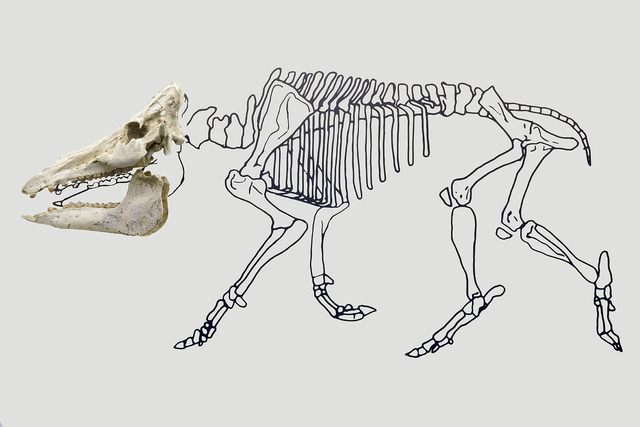
23. WILD BOARS: HIPPOPOTAMODON MAJOR
Suidae are a group of artiodactyls (mammals with cloven hooves, split into two small toes) that includes pigs, wild boars, warthogs, and other related forms.
During the Miocene, Hippopotamodon major was a common species in mid-latitudes in Eurasia, from the Iberian Peninsula in the west to the Far East. It is absent from Africa.
From its dentition (teeth development and their arrangement), we know it was omnivorous. The circular musculature of its snout reveals that it routinely foraged for food on the ground (rooting). Many suids use their nasal discs as mobile digging tools to extract tubers, roots, fungi, or small animals from soft soil. This is coupled with an excellent sense of smell, which allows them to detect anything edible, even when it is buried underground.
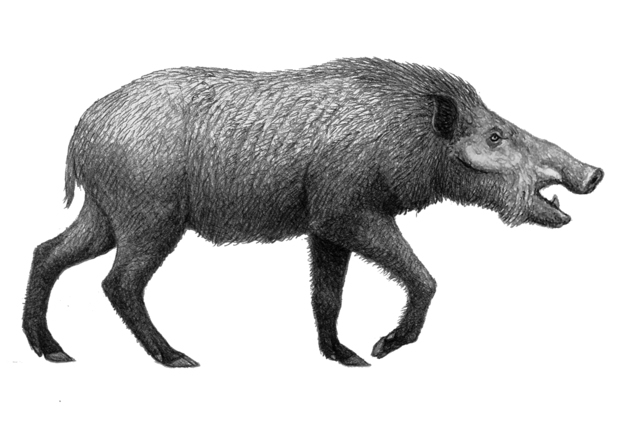 Genus: Hippopotamodon
Species: Hippopotamodon major
Height at shoulders: 1 - 1.20 m
Period: Upper Miocene
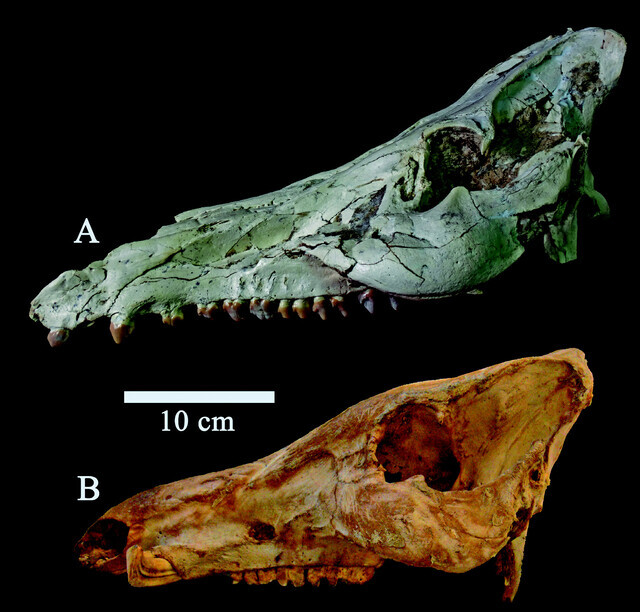 Hippopotamodon major was an enormous pig, significantly larger than the largest living wild boar. Comparing the skull of Hippopotamodon major (A) with the skull of an adult male Hylocherus meinertzhageni (forest hog), the largest living suid, shows that the Miocene species was more than 20% larger.
It probably weighed between 390 and 430 kg, although Hippopotamodon species were sexually dimorphic, with females being noticeably smaller in size.