
1. WELCOME
The “Emiliano Aguirre” Paleontology Room, dedicated to the great Spanish paleontologist, presents visitors with an astonishing view of Madrid before the advent of humankind. A full understanding of our history as human beings cannot be achieved without understanding that our genus Homo did not arise out of nowhere.
Starting with the geological evolution of Madrid, the tour attempts to convey, through fossils, animal reconstructions, and landscape illustrations, among other elements, the paleontological richness of the region, which once had a variety of fauna similar to that found today in the African savannahs.
The Community of Madrid is particularly rich in animal remains, especially from the Miocene period (between 23 and 5 million years ago), with some sites such as Cerro de los Batallones, a true world reference for its taxonomic and taphonomic interest.
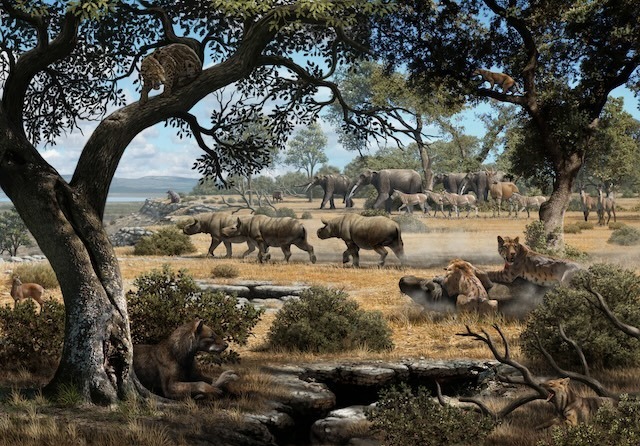
During the Cenozoic (the epoch formerly known as the Tertiary) mammals experienced an unprecedented evolutionary radiation, occupying most of the available ecological niches. It is known as the ‘Age of Mammals’. The richness and preservation of the Miocene fossils from Madrid reveal a surprising faunal diversity. The illustration shows how the top of the Cerro de los Batallones site (Torrejón de Velasco) looked about 9 million years ago.
Illustration: M. Antón