
4. FROM MYTH TO SCIENCE
Palaeontology as a scientific discipline emerged in Spain in the mid-19th century, and is closely linked to the first fossil discoveries on the terraces of the Manzanares River, and surrounding areas (central Iberian Peninsula).
During the 20th century, palaeontology became more professional, with figures such as José Royo Gómez and Eduardo Hernández-Pacheco. After the Spanish Civil War, in the second half of the 20th century, prominent figures such as Miguel Crusafont, Bermudo Meléndez, and Emiliano Aguirre trained a whole new generation of geologists, biologists, and palaeontologists.
Spain’s economic development, and the surge in research in recent decades, have led institutions such as the National Museum of Natural Sciences (CSIC) to promote high-level multidisciplinary projects to study the Madrid Basin (an intraplate Cenozoic basin located in the central area of the Iberian Peninsula), an area that is internationally known for its unique geological and palaeontological wealth.
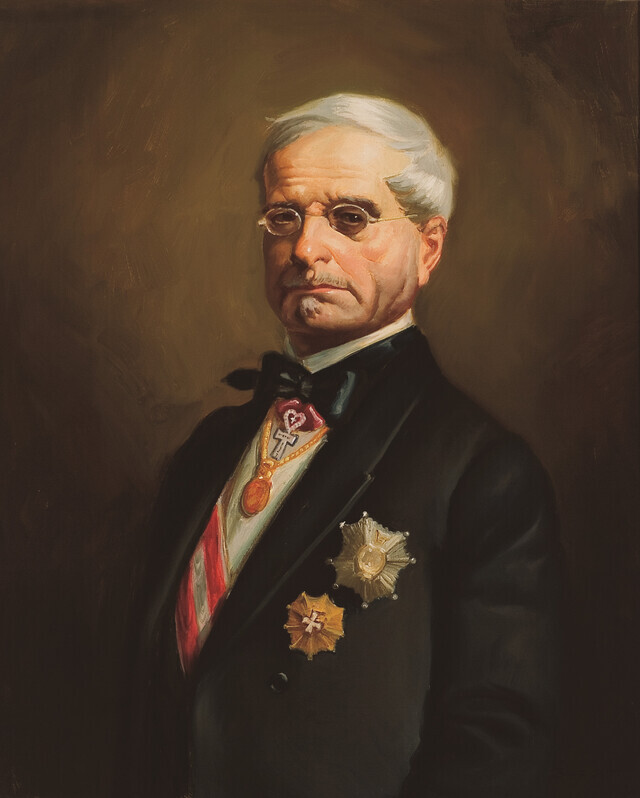
Casiano del Prado y Vallo (b. 1797 – d. 1866), a mining engineer and member of the Commission for the Geological Map of Spain. He was a pioneer and precursor of prehistoric archaeology and palaeontology, among other scientific fields. His work formed part of a broader movement that included engineers such as Schultz, Ezquerra del Bayo, and Amar de la Torre, and geologists such as Hausmann and Verneuil.
Casiano del Prado y Vallo, after an oil painting by Ignacio Burguete (I.G.M.E., Geological and Mining Institute of Spain)
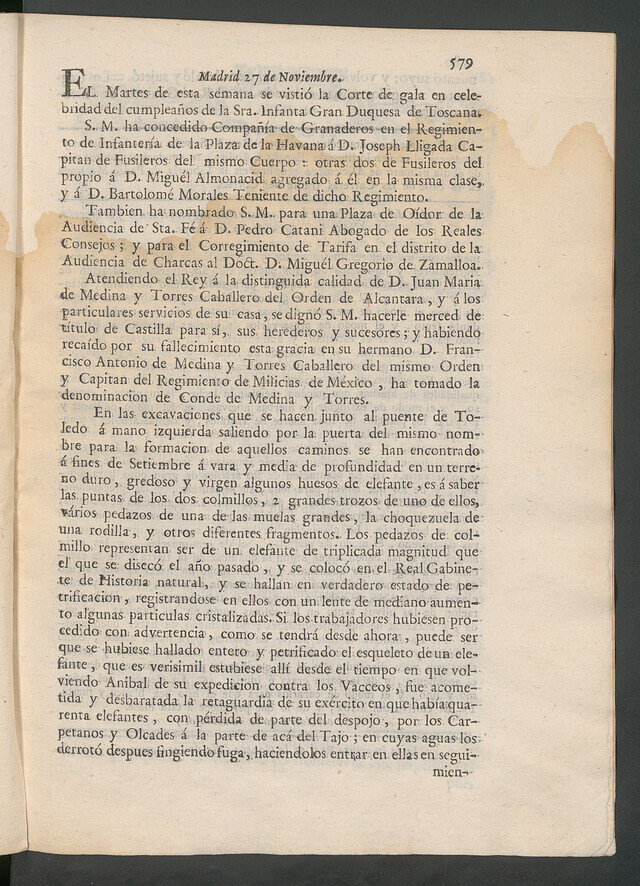
The Madrid Gazette (Gazeta de Madrid), Friday, November 27, 1778, reporting the discovery of fossil remains near the Bridge of Toledo (constructed 1718-1732), at that time attributed to the elephants of Hannibal’s army as they passed through the Iberian Peninsula.