
9. THE MIOCENE OF MADRID
The Madrid Basin has many sites containing fossil mammals from the Miocene. The City of Madrid was built on land from this geological period.
The Cenozoic, which includes the Miocene (between 23.2 and 5.3 million years ago), is known as the “age of mammals”. In the Madrid Basin, most of the sites date back to this period. Although the sedimentary basin fill can reach 3,000 metres in thickness, only the most recent sites appear on the surface, either because they have been exposed by the erosional activity of the river network during the Quaternary and the present day, or because of human activities.
During the Miocene (and especially during the Middle and Upper Aragonian, within the Middle Miocene: between 16 and 11 million years ago) most of the mammalian fauna of the region is found in what was once a wide savannah around a shallow central lake, with abundant marshes and ponds on the edges.
At the end of the Miocene, important changes in faunal associations occurred, known as the “Vallesian Crisis” (between 10 and 9 million years ago), which favoured the expansion of species that were adapted to more arid and open environments, due to the progressive cooling that began in the Middle Miocene.
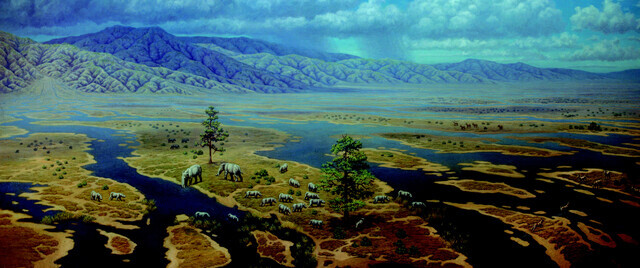
Landscape of the Madrid region during the Middle Aragonian.
Illustration: M. AntónThe Miocene sites of Madrid cover approximately between 20 and 9 million years ago. Biochronologically, the sites comprise the Ramblian (Lower Miocene), Middle Aragonian (Middle Miocene), Upper Aragonian (Middle Miocene), and Upper Vallesian (Upper Miocene) periods.
LOWER MIOCENE
Upper Ramblian: the centre of the Madrid Basin is occupied by a large marshy and brackish area.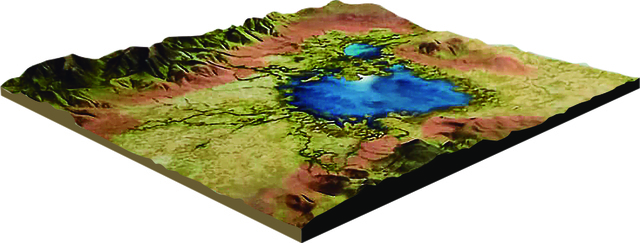
MIDDLE MIOCENE
Lower Aragonian: The uplift of the Central System began, which contributed more sediment to the basin as it eroded.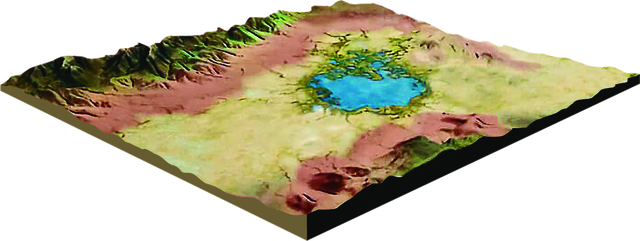
Upper Aragonian: The central flooded area expanded, and its margins became covered with vegetation in greater abundance.
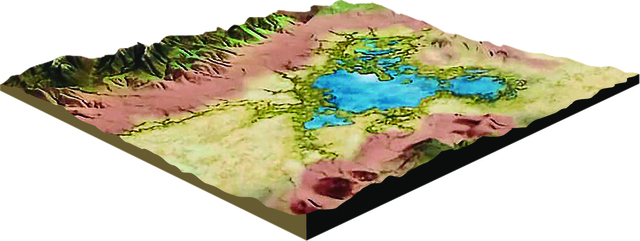
UPPER MIOCENE
Vallesian: The salinity of the water changed drastically, forming a freshwater lake that occupied a large part of the central Madrid basin, reaching its maximum extension.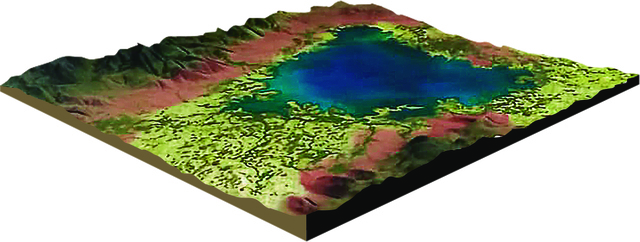
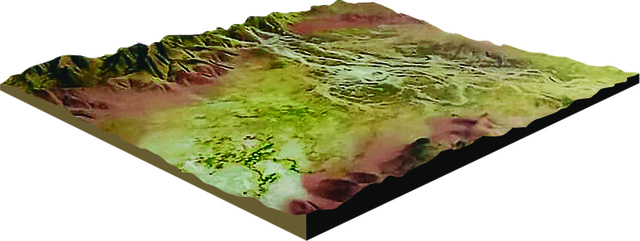
Turolian: The Madrid basin gradually silted up, and the first connections to the proto-river network appeared, thus marking the beginning of the disappearance of the large central lake.
Illustrations: O. Sanisidro