
10. CERRO DE LOS BATALLONES SITE
The palaeontological site of Cerro de los Batallones is unique in the world, due to its exceptional preservation of continental vertebrates.
The deposits at Cerro de los Batallones (Torrejón de Velasco) are located on what is known as a “witness hill” (a land form elevation that has resisted erosion and is, therefore, a testimony to sediments from past periods). Subsurface erosion processes formed a network of tunnels and cavities in the hill that, during the Vallesian (between 11 and 9 million years ago, Upper Miocene), acted as natural traps for the surrounding fauna.
The fauna found in some sites on the hill forms two groups: one in the lower sedimentary levels, characterised by the accumulation of carnivorous mammals, and another in the upper levels, where herbivores predominate. The discovery of connected anatomical remains is very common.
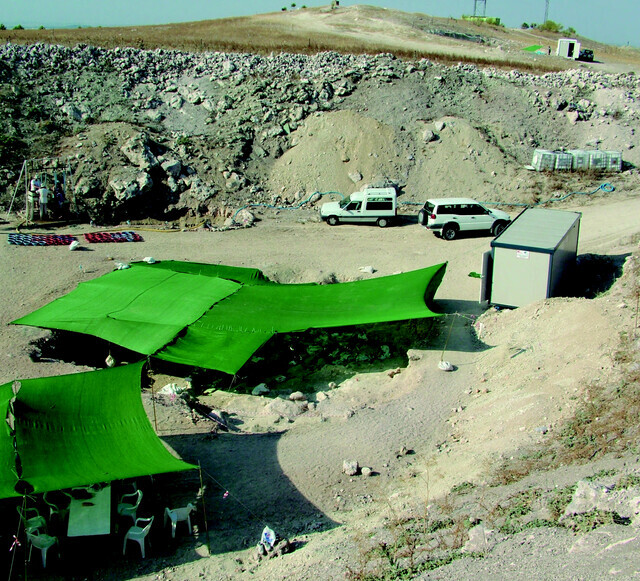
Image: Cerro de los Batallones - 1st Campaign, 2006
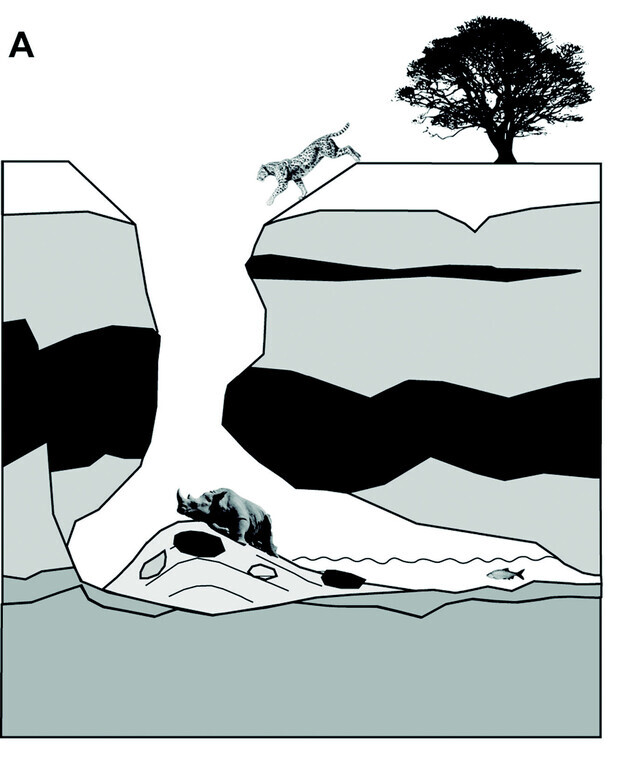 A- Over time, carnivores entered the cavity in search of food and water: then, they became trapped, and they died.
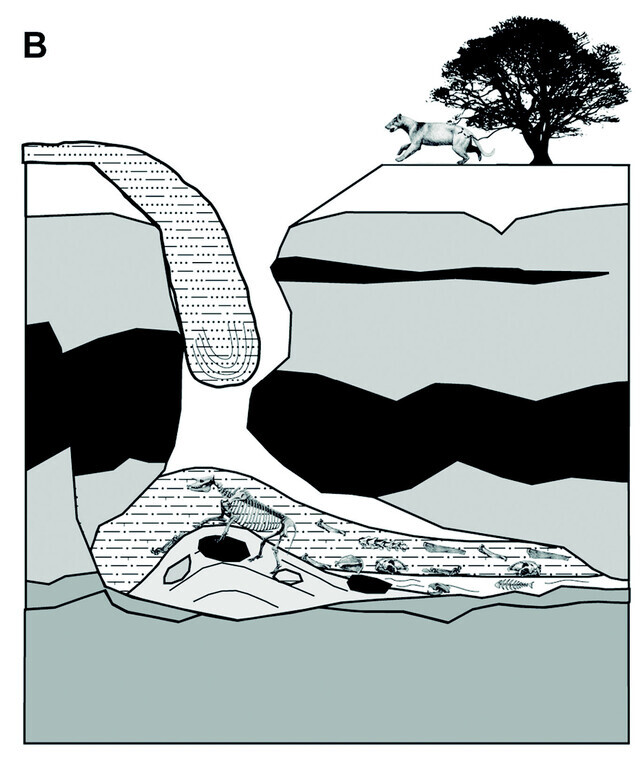 B- Episodic streams introduced sediments into the cavity, thus burying the remains, while carnivores repeatedly entered.
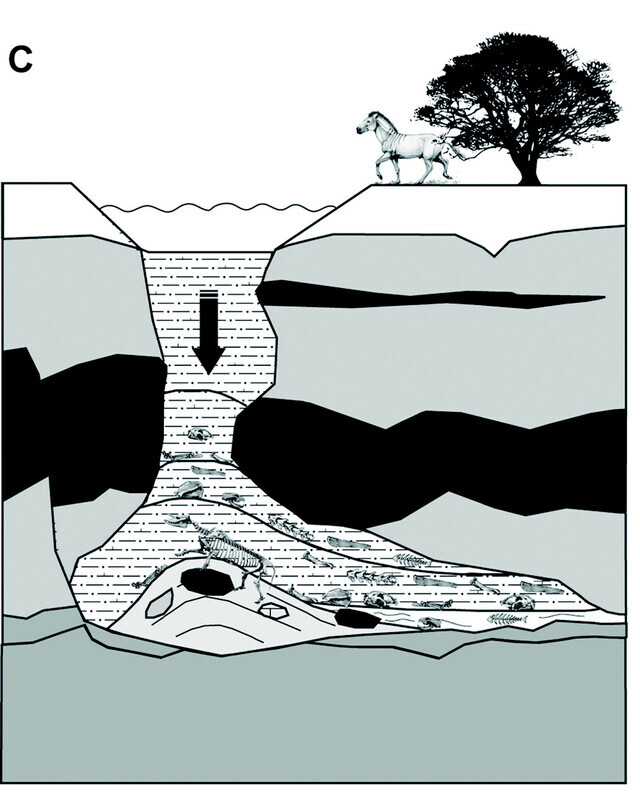 C- The pressure of the sediment caused fractures, collapses, and deformations of the bones. This is the final stage of cavity filling.
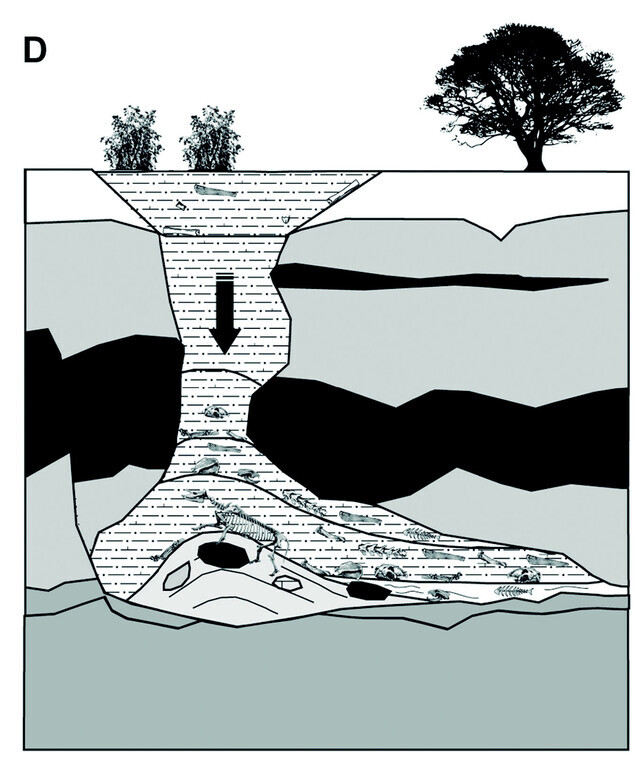 D- Accumulation of herbivore remains in the upper, flooded level.
Sequence of the formation of the deposits at Cerro de los Batallones
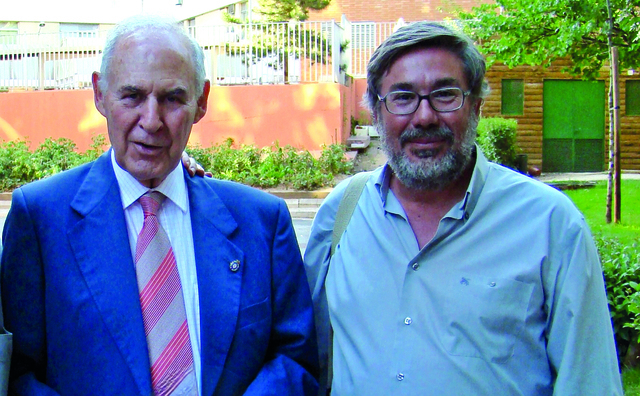 These exceptional sites have been excavated during numerous campaigns by a research team from the National Museum of Natural Sciences (CSIC), led by Jorge Morales, in collaboration with professors and students from several Spanish universities.
Image by Emilio Aguirre and Jorge Morales
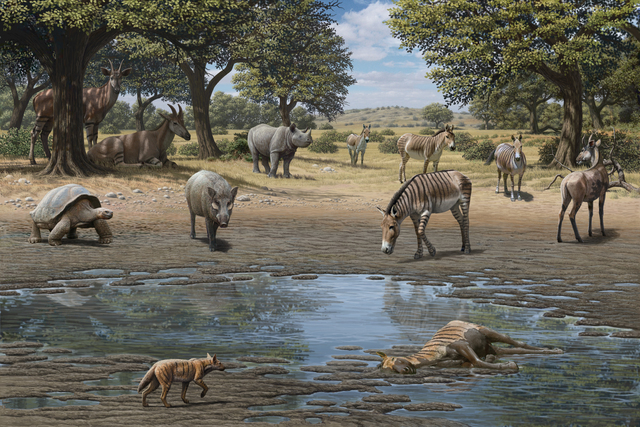
Reconstruction of the Cerro de los Batallones 10 site (Torrejón de Velasco) during the Late Vallesian period, approximately 9.1 million years ago (Upper Miocene), in the final stage of its formation. The original cavity was almost filled in, with a pool accumulating in the centre of a muddy depression, thus attracting thirsty animals, which then became trapped in the sticky mud. Numerous herbivore fossils have been found.
Illustration: M. Antón
Camera, description, and editing: Mauricio Antón and Miguel Antón
Archive images are courtesy of the research team at the Cerro de los Batallones site
Duration: 2:48 minutes
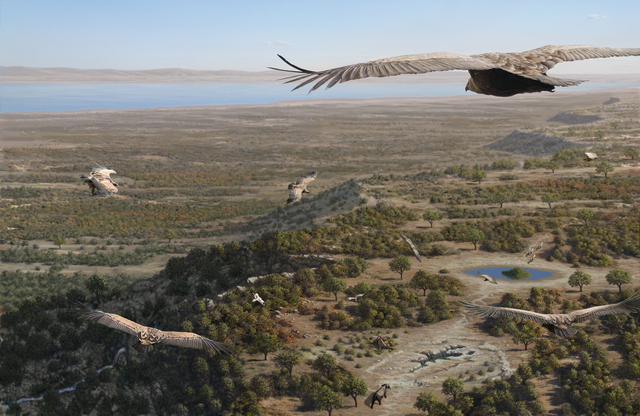
Reconstruction of the aerial view of the landscape of the Cerro de los Batallones site (Torrejón de Velasco) 9 million years ago. In the foreground is the hill with its system of cavities: the nearest cavity is fully operational, and the farthest is already close to undergoing colmatation (clogging), and being transformed into an ephemeral pool, where large herbivores would have been trapped.
Illustration: M. Antón
Camera, script, and editing: Mauricio Antón and Miguel Antón
3D Animation: Antonio Jiménez
Archive images are courtesy of the research team at the Cerro de los Batallones site
Duration: 3:40 min