
26. TRANSITION TO THE PLEISTOCENE
At the end of the Cenozoic Era, a palaeogeographic event took place, that would determine the future of the Madrid Basin: the capture of the basin by the Tagus River and its opening to the Atlantic Ocean. This change occurred with the arrival of the Quaternary, 2.6 million years ago.
The Quaternary is the last period in the history of Earth, spanning 2.6 million years to the present. It is further divided into the Pleistocene (with a climate alternating between glacial and warm periods), and the Holocene, which is the current geological epoch that began approximately 11,700 years ago (the period in which the climate was similar to the climate of today).
Geologically, it is characterised as the period in which the river network of the Madrid region was configured. Erosion dominated the deposition of new sediments, and the basin gradually emptied as the river courses embedded in the materials that were accumulated throughout the Tertiary.
From then on, sedimentation was largely limited to the formation of fluvial terraces in the middle and lower reaches of rivers. The terraces became records of all the events that occurred throughout the Pleistocene, with the climatic alternation of warm (interglacial) and cold (ice ages) periods, and a succession of fauna, including the various hominin species (of which only one species is in existence today, Homo sapiens) we know from the tools they made, the remains of the prey they consumed, and in some cases, from their anatomical remains.
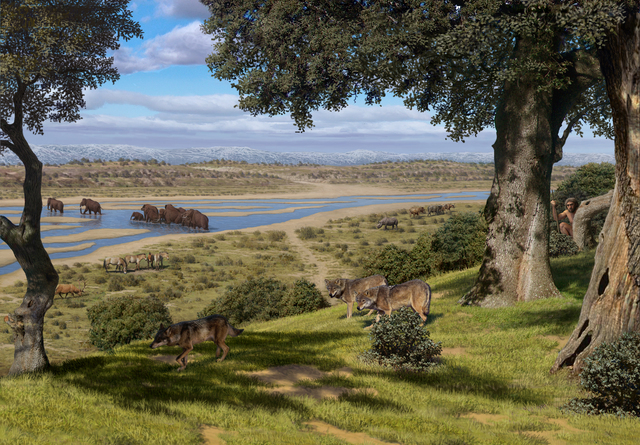 The Pleistocene fauna of Madrid originates primarily from the fluvial terraces of the Manzanares and Jarama rivers. This scene recreates the documented environment in the Manzanares Valley at the end of the Middle Pleistocene, which was around 200,000 years ago.
Illustration: M. Antón
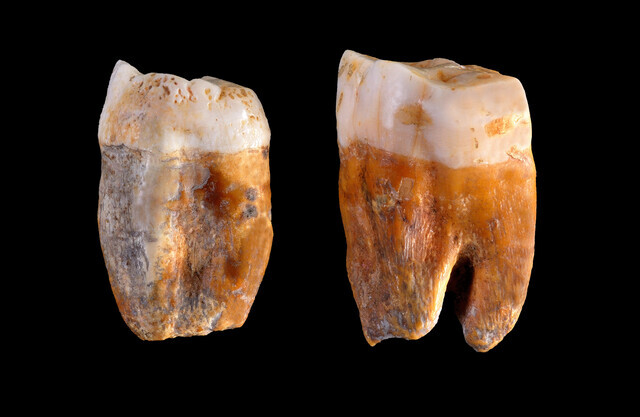 Molars of Homo neanderthalensis from the Calvero de la Higuera site (Pinilla del Valle). Middle-Upper Pleistocene.
Image: MAR / M. Torquemada