
7. THE FOSSIL RECORD OF LIFE
The fossil record allows us to reconstruct the history of life on Earth, and the most significant milestones in the evolution of living organism over the past 3.5 billion years.
Fossils are understood as the evidence left by organisms in rocks over the more than 3.5 billion years of life on Earth, and the “fossil record” as the set of direct and indirect evidence left by organisms over time.
The Earth’s geological and palaeontological record reveals the presence of associations of different organisms that provide evidence for the existence of significant climatic fluctuations. This relationship between organic change and climate change was recognised from the beginning by scientists in Palaeontology and Geology: organisms have changed to adapt to new environmental conditions, and compete with other organisms.
Fossils are the only direct evidence of this process, which is called evolution.
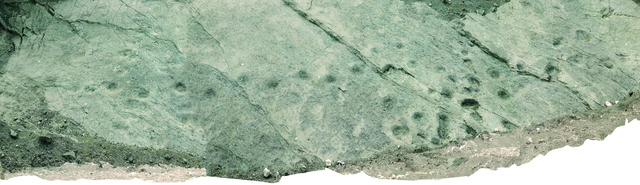
Fossils are vestiges of past biological processes and include indirect evidence of the activities of organisms (footprints, tracks, ducts, etc.). In Madrid, there is an excellent example of this type of evidence, because at the Casa Montero site, there is a trace composed of more than 70 ichnites (fossilised footprints) of mastodons dating back 14 million years.
Image: J. Latova
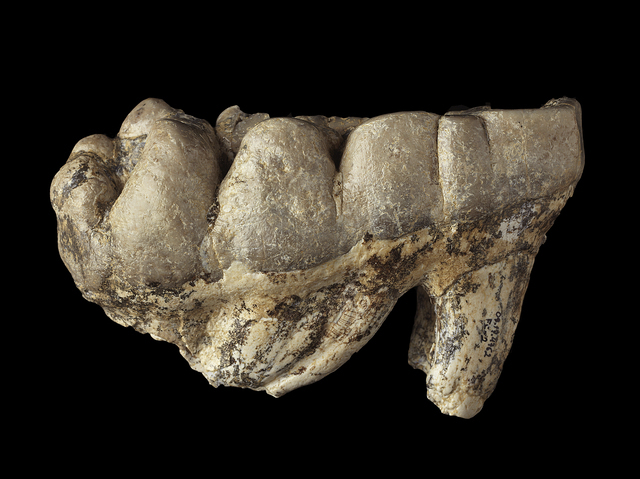
Gomphotherium angustidens molar from the underground train station of Carpetana (Madrid).
Late Middle Aragonian (147–13 Ma)
Image: M. Torquemada / MAR