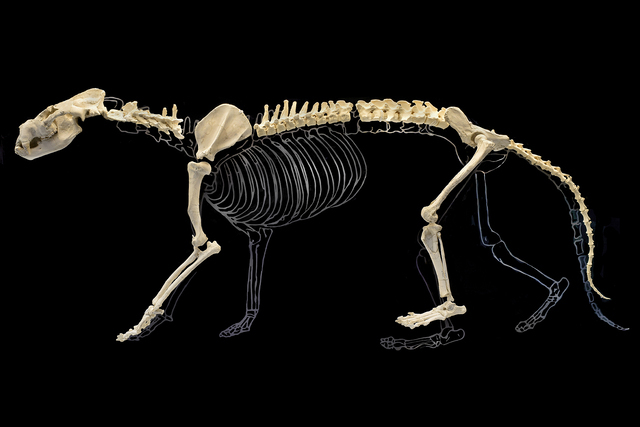
11. CARNIVORES: THE AMPHICYONIDS
Amphicyonids were a group of carnivores that were widely distributed across Eurasia, North America, and Africa from the Middle Eocene (40 million years ago).
Although they are occasionally called “bear dogs” due to their apparent similarities to canids and ursids, amphicyonids constitute a family of their own, which is distinct from other carnivores.
Amphicyonids were highly successful in the evolutionary sense, and they occupied the niche of large predators in terrestrial ecosystems, while competing directly with sabre-toothed cats. Throughout the Miocene, amphicyonid diversity declined, followed by an eventual extinction during the Upper Miocene (6 million years ago).
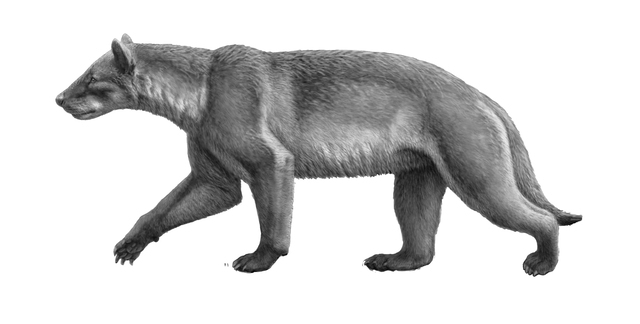 Genus: Magericyon
Species: Magericyon anceps
Height at shoulders: 78 cm
Period: Upper Miocene
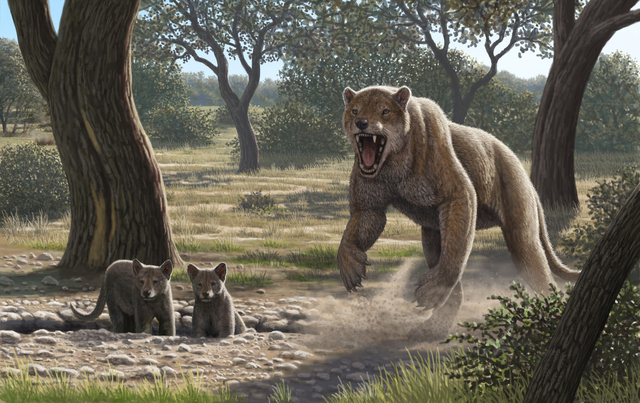 Magericyon anceps was a large amphicyonid, weighing up to 200 kg, making it one of the largest predators of its time. It had very sharp teeth, that were specialised for eating meat (hypercarnivorous). The morphology of its skull and cervical vertebrae would have allowed it to make powerful movements of its neck and head, thereby increasing the effectiveness of its bite.
Illustration: M. Antón