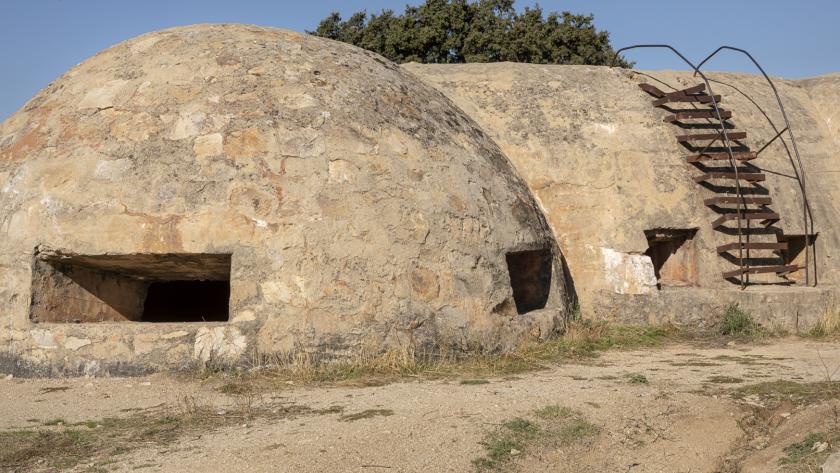
Blockhaus-13 in Colmenar del Arroyo

Blockhaus-13 is an imposing reinforced concrete fortification located approximately two kilometers northeast of the town of Colmenar de Arroyo. It consists of a main structure 10 meters in diameter, from which four smaller bunkers are accessed, all equipped with embrasures that allow for complete control of the surrounding area. The fort has a footprint of approximately 160 square meters and a height of just over two meters above ground level.
Blockhaus-13 is the only building of this type completed in the Community of Madrid and is one of the few examples for which there is concrete data on the context of its construction, from its planning to how and who built it, the 2nd Company of the 7th Sapper Battalion.
This structure, therefore, constitutes the highest expression of the military architecture of the Civil War in the Community of Madrid and is therefore protected as an Asset of Cultural Interest.

History of Blockhaus-13
The town of Colmenar del Arroyo was occupied by the rebel army in November 1936, becoming from that moment on an area for the encampment of troops serving the front line.
At the end of 1938, fearing a potential Republican offensive in this sector and others, the rebel commanders ordered the creation of a network of strategically located defenses along communication routes, allowing them to counter the threat with a limited number of troops. To this end, they ordered the construction of a series of concrete fortifications, or blockhouses, along the main roads of the region.
El German term blockhouse It was adopted during the First World War by the French to describe concrete constructions carried out following the stabilization of the western front.
On November 20, 1938, the commanding general of the Army of the Center transmitted to the command of the 71st Division, responsible for the defense of this sector, the order to build these elements of resistance.
At least two fortified points had to be established on each road, one located near the front and the other at the rear at a distance
4-5 kilometers. These blockhouses were to consist of a impact-resistant concrete fortification of projectiles of all calibers used at the time and also have the capacity to fire throughout its perimeter.
They should also be surrounded by additional defenses well-placed fortifications (barbed wire, ditches, anti-tank mines) and loopholes for automatic weapons and rifles. Inside, they were to accumulate
the necessary supplies (ammunition, food, water and medical supplies) to ensure the maintenance of the position at all costs.
By the end of December 1938, several of these fortifications were already under construction, and although 18 were initially planned, only the so-called Blockhouse number 13 was ever completed. The end of the war (April 1, 1939) precipitated the abandonment of work on the remaining fortifications.
The town of Colmenar del Arroyo was occupied by the rebel army in November 1936, becoming from that moment on an area for the encampment of troops serving the front line.
At the end of 1938, fearing a potential Republican offensive in this sector and others, the rebel commanders ordered the creation of a network of strategically located defenses along communication routes, allowing them to counter the threat with a limited number of troops. To this end, they ordered the construction of a series of concrete fortifications, or blockhouses, along the main roads of the region.
El German term blockhouse It was adopted during the First World War by the French to describe concrete constructions carried out following the stabilization of the western front.
On November 20, 1938, the commanding general of the Army of the Center transmitted to the command of the 71st Division, responsible for the defense of this sector, the order to build these elements of resistance.
At least two fortified points had to be established on each road, one located near the front and the other at the rear at a distance
4-5 kilometers. These blockhouses were to consist of a impact-resistant concrete fortification of projectiles of all calibers used at the time and also have the capacity to fire throughout its perimeter.
They should also be surrounded by additional defenses well-placed fortifications (barbed wire, ditches, anti-tank mines) and loopholes for automatic weapons and rifles. Inside, they were to accumulate
the necessary supplies (ammunition, food, water and medical supplies) to ensure the maintenance of the position at all costs.
By the end of December 1938, several of these fortifications were already under construction, and although 18 were initially planned, only the so-called Blockhouse number 13 was ever completed. The end of the war (April 1, 1939) precipitated the abandonment of work on the remaining fortifications.